Root-destroying pests are the enemy that hides underground. Because you can’t see the damage unfolding, their feeding usually mimics drought or disease, showing up as wilting, stunted growth, or yellowing leaves.
There are microscopic pests like root-knot nematodes, insect larvae like grubs and maggots, and sap-suckers like root aphids. That’s not even getting into the burrowing mammals like gophers and voles.
Not to worry. There are plenty of ways to make your garden less inviting to these underground pests and handle them once they’ve arrived.
Let’s look at what kind of damage these vegetable garden pests cause, how to keep their destruction to a minimum, and how to treat them organically.
Note: We’ll focus on insect pests that cause damage at the soil level. Animals that burrow and destroy the roots of your plants deserve their own post.

This post contains affiliate links, which means I earn a small profit when you click on the link and purchase my recommendations. As an Amazon Associate I earn from qualifying purchases. Thanks for supporting my small business!
SIGNS OF PEST DAMAGE
If a root-destroying pest has made its home in your soil, here’s the type of damage you can expect to find:
- Loss of recently planted crops
- Bumpy knots and swellings on roots
- Yellowing or purpling of outer leaves
- Slow or stalled plant growth
- Wilting crops despite wet soil
- Reduced flower, fruit, or leaf production
- White cotton-like fuzz on roots
- Tunnels created in root crops
ROOT-DESTROYING PESTS
Here are just a few of the pests that attack the roots of your plants:
- Cabbage root fly larvae
- Carrot rust fly larvae
- Invasive jumping worms
- Root aphids
- Root-knot nematodes
- White grubs
- Wireworms
While prevention will, for the most part, look the same for these pests, your best course of action may depend on which of these creepy crawlies is attacking the roots of your vegetables.
So first, I’ll help you identify your garden’s new foe based on their physical characteristics and the damage they cause. Then, we’ll look at how to take targeted action against them.
Cabbage Root Fly & Carrot Rust Fly Larvae
(Delia radicum, Psila rosae)
Cabbage root flies and carrot rust flies are not the problem. It’s their larvae. They lay their eggs near host plants, and then their babies burrow into the soil and start feeding on plant roots.
Fly Larvae Identification
- Cabbage root fly larvae and carrot rust fly larvae are legless white maggots.
- Cabbage root flies have hump-backed grayish brown bodies and are about 5 to 7 mm long.
- Carrot rust flies are small and have shiny black bodies, an orange head, clear wings, and dark red eyes. Their beige-colored larvae deposit rust-colored frass in underground tunnels.
- These pests lay tiny white eggs in the soil.
Plants Affected
- Cabbage root flies attack brassicas like cabbage, broccoli, radishes, and cauliflower. They also like root crops like carrots and parsnips.
- Carrot rust fly larvae attack carrots and other plants in the carrot family, including parsnips, parsley, and celery.

Asian Jumping Worms
(Amynthas agrestis, Amynthas tokioensis, and Metaphire hilgendorfi)
Earthworms are one of the best things you can have in your garden: they tunnel through the soil, keeping it nice and loose, and their castings (poop) provide a wonderful source of nutrients for your plants. Unfortunately, they have a non-beneficial cousin that’s become invasive in the US. These worms live just below the surface, so they don’t provide any soil benefits like aeration or increased water absorption. They can quickly eat their way through leaf litter on the soil surface. Not even their castings are good.
Asian Jumping Worm Identification
- Asian jumping worms can be anywhere between 1 and 8 inches long.
- They thrash around violently when disturbed, like a snake.
- Their skin is shinier, smoother, and drier than typical earthworms, and they also tend to be darker in color. Look for a smooth, milky-white to light-gray band that completely circles the worm’s body and lies flush rather than raised.
- Their castings look like coffee grounds on the soil surface.
- These worms hang out in clumps, so if you see a large number of worms near the surface of the soil, it’s a safe bet they’re jumping worms.
Plants Affected
- These worms are bad news for your entire garden. They will slowly degrade your soil quality.
- They can also live in your compost pile and landscaping.

Root Aphids
(Many species)
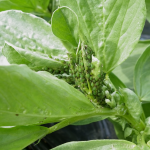
These pests use their mouth parts to drain plant roots. They crawl slowly beneath the surface, sucking vital sap and draining the host plant of energy. These pests are often spread underground by ants, which feed on their honeydew (that’s their poop). Ants even help pest eggs overwinter in the soil.
Root Aphid Identification
- Root aphids are small, waxy insects (often white) that secrete a fuzzy substance on roots.
- They’re just 2 to 3 mm long.
- They can be winged or wingless, depending on life stage.
Plants Affected
- Root aphids feed on lettuce, cabbage, carrots, or beans, depending on the species.

Root-Knot Nematodes
(Many species from the genus Meloidogyne)
The result of these microscopic pests’ underground feeding is swollen knots on the roots, stunted growth, and wilting thanks to the plant no longer being able to absorb water and nutrients.
Root-Knot Nematode Identification
- Nematodes are teeny tiny unsegmented roundworms.
- The knots they form are swellings of the root and cannot be rubbed away or pressed.
Plants Affected
- Any annual or perennial plant could be a target, especially in warm, wet soils.
- They particularly like broadleaf plants like legumes, fruit trees, and nut trees.

White Grubs & Wireworms
(Many species)
Grubs chew through roots and cause dropping leaves and sudden plant collapse. They’re mostly known as a lawn pest, but they sometimes feed on veggies. They can also cause problems if their presence invites burrowing animals like moles to dig through your soil, looking for a tasty grub snack.
Wireworms tunnel through root vegetables, cause poor seed germination, and stunt plant growth.
Grub & Wireworm Identification
- Wireworms are the hard-bodied, long, slender larvae of click beetles. They’re shiny and yellowish-brown.
- White grubs are the C-shaped larvae of scarab beetles, including Japanese beetles. They have soft, white or gray bodies and orange-brown heads. Their 6 legs are concentrated near their heads.
Plants Affected
- Wireworms attack root vegetables, tubers (like potatoes), corn, grain seeds, and young vegetable seedlings.
- White grubs mostly eat grass species. They’ll also target corn, potatoes, flowers, and other vegetables.

HOW TO PROTECT YOUR PLANTS FROM GRUBS, JUMPING WORMS, & OTHER PESTS
Follow best gardening practices to make your garden less appealing to these root-destroying pests looking for a cozy underground home. That includes the following:
Rotate Crops
Practice crop rotation next season if fly and gnat larvae have been an issue. Many adult flies don’t travel very far when looking for egg-laying sites.
Buy the Right Plants
Choose pest-resistant varieties. You can buy, for example, carrots seeds for varieties that are resistant to carrot rust fly.
Cover Your Garden
Cover newly planted garden beds with agfabric or floating row covers to prevent adults from accessing host plants for egg laying. This only works if pests weren’t present last year or if you’ve practiced crop rotation, since pupae left in the soil last year can emerge.

Plant Herbs & Flowers
Plant aromatic herbs like thyme and onion family plants (onions, garlic, chives) to mask the scent of carrots and other crops from adult carrot rust flies looking for host plants.
Grow flowers like French marigolds, which are especially useful in deterring nematodes.
👉 Learn more about our favorite flowers to companion plant with veggies.

Clean Your Garden Before Winter
In the fall, till the top layer of soil to expose and help reduce pupae hoping to overwinter in the soil. Make sure to pick up any leaf litter on the soil surface.
Avoid covering your garden in heavy pieces of mulch or letting too much leaf litter accumulate on the surface. This is attractive to jumping worms.
Shop Smart
Pull nursery plants from their pots and carefully inspect the roots before bringing them home. Replant in fresh soil if you suspect any pest presence.
Use only soil, amendments, and plants obtained from reliable suppliers. For bulk soil and compost, check to make sure the supplier applies heat treatments to sterilize.
Water Wise
Keep your garden well watered and fed to reduce any stress that soil-dwelling pests can cause plants.
Improve drainage in heavy, wet garden areas by digging down and mixing compost and coarse sand with the existing soil.
HOW TO GET RID OF JUMPING WORMS, CARROT RUST FLIES, & OTHER PESTS
Follow these steps to treat any problems in your garden:
Step 1: Remove Visible Pests
Manually remove and destroy any grubs or jumping worms you encounter while turning over garden soil.
Pull plants that root aphids or nematodes attacking the roots.
Harvest crops like carrots early if needed.
Pro Tip:
Thoroughly wash any tools that have come into contact with infested plant parts and soil.
Step 2: Treat the Soil
I wish I could tell you there’s one spray you can apply to solve your problem. But that’s not how it works. You actually want to avoid broad-spectrum pesticides. Your best course of treatment depends on the pests you believe are the issue.
For Root Aphids and Mealybugs
Simple homemade insecticidal soap can be effective against root aphids and mealybugs. You’ll make a root drench to pour over infested soil.
What is a soil root drench?
This technique involves pouring treatments directly over the soil around a plant’s root zone. You want to completely saturate the soil in problem areas.
If your soil is dried out, pre-moisten it by watering 24 hours before the root drench to improve absorption. If you’re using a store-bought insecticidal soap, make sure to dilute the product correctly and follow the label instructions. Pour your solution slowly over the root zone in multiple passes.
Soil Root Drench Recipe
- gallon of warm water
- 2 tsp castille soap
- 2 T neem oil (cold pressed)
Mix vigorously and pour over roots of plants, avoiding leaves.
Another option is to dump infested soil, spray the roots thoroughly with water, and re-plant in a well-cleaned container. Never transfer soil from infested plants to healthy plants.
For All Root Pests
There’s a simple, non-chemical way to treat the soil. It’s called solarization. You can solarize your soil by covering moist soil with clear plastic during the hot summer months to trap heat and kill soil-dwelling pests and their eggs. You just need the top couple inches of soil to reach 104°F for at least three days to kill them.
For Fly Larvae, Wireworms, and Grubs
You can buy and apply beneficial nematodes to the soil to combat fly larvae, wireworms, and grubs. Yes, there are good nematodes and bad nematodes. The most beneficial are those in the genus Steinernema. These beneficial nematodes need a moist soil environment to survive. You’ll apply them as a soil drench (see above) according to package instructions.
Step 3: Focus on Soil Health
Improve soil health by adding compost and supporting beneficial microorganisms that fight off soil-borne pests. It may sound counterintuitive, but avoid pesticides and synthetic fertilizers, both of which are harmful to these beneficial microorganisms.
You also want to avoid insecticides that would cause harm to natural enemies of soil-dwelling pests, such as ground beetles, which feed on maggot eggs, larvae, and pupae.
If you found this article helpful, please share it with others! As always, feel free to ask questions in the comments. I’d love to know which pests are bugging you!
👉Dealing with sap-sucking pests like aphids, spider mites, mealybugs, or whiteflies? Don’t miss this post.
👉Check out this post on dealing with common pests like Japanese beetles, hornworms, slugs, and other large chewing pests.
👉And don’t miss this post on squash bugs, stink bugs, and more.